Free browser game / top-down / single-player / PC only
Bring a 236-metre tug-and-barge into the dock the way real crews do it.
Chrome or Edge on a PC. Keyboard and mouse.
01 / What it is
A docking simulator, not a boat game.
You are at the controls of an articulated tug-barge: a 216-metre barge with a 40-metre tug locked in its notch. The view is top-down, the controls are the real ones, and the only question is whether you can put the unit alongside a quay the way an ATB crew actually does it.
Lines are the real tool
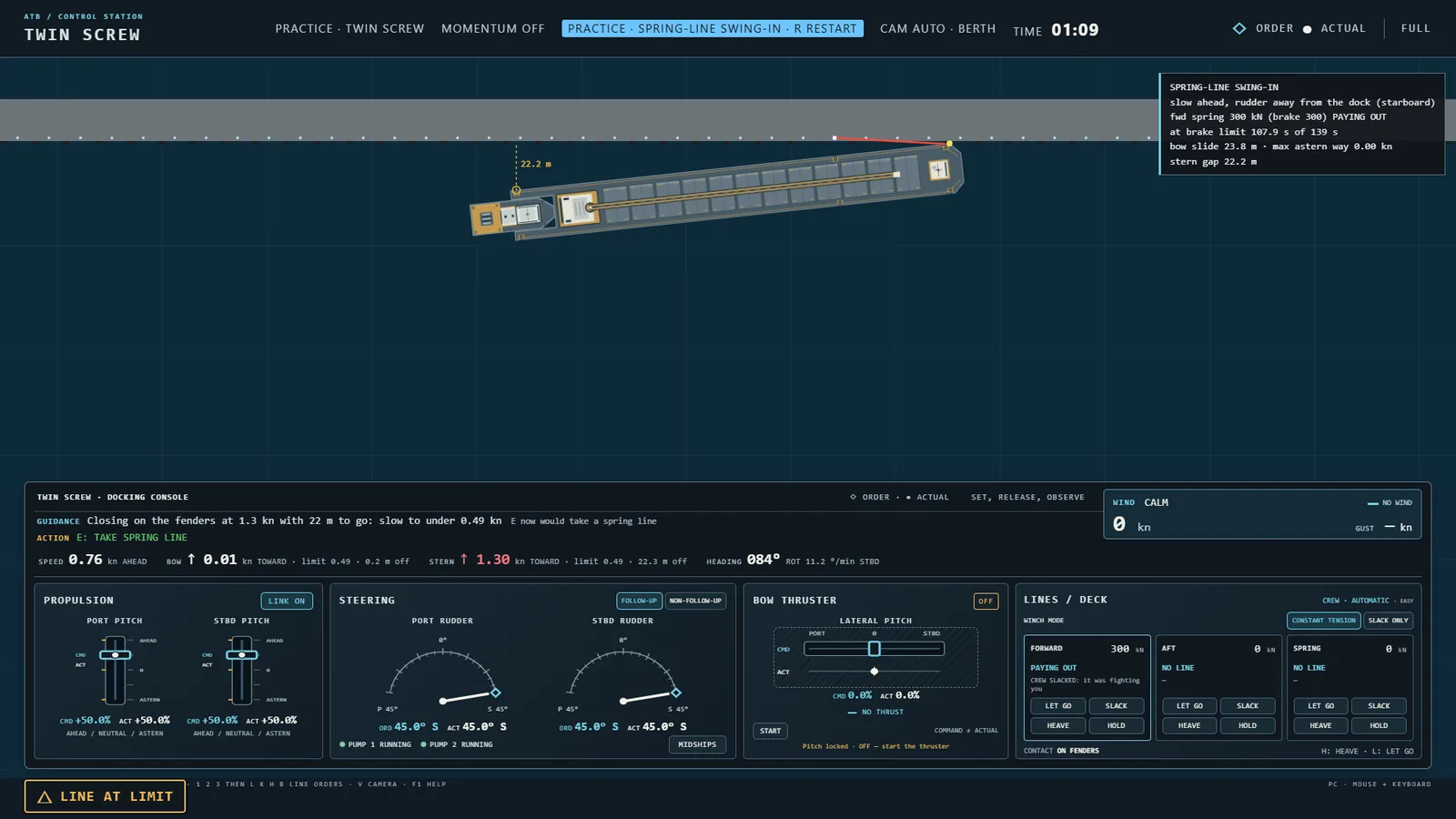
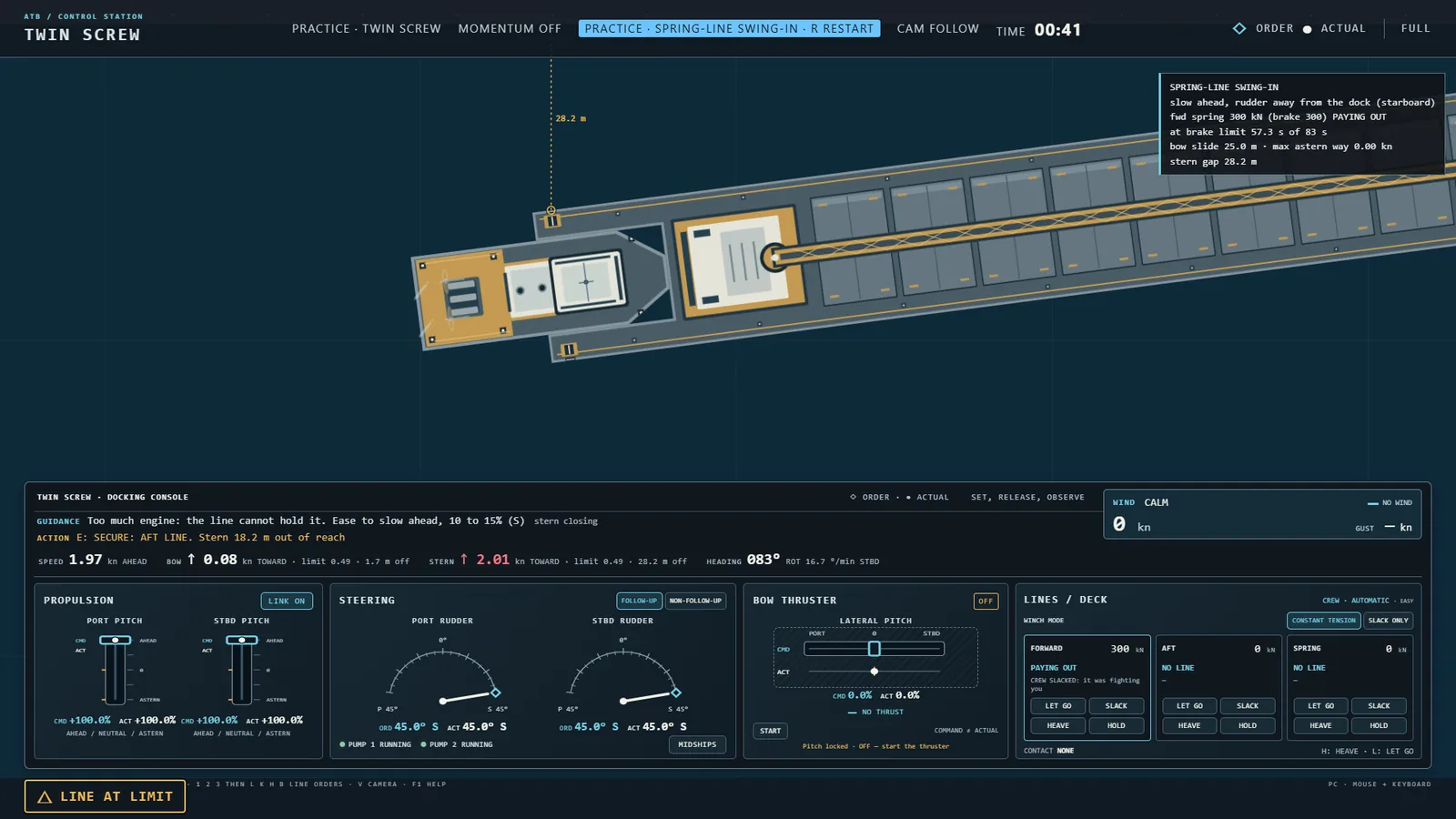
Take a forward line on a spring lead, hold slow ahead with the rudder away from the dock, and let the stern walk in. Call the deck crew: heave, slack, hold, let go. On the easy tiers the crew works the winches for you. On the hard tiers you call every line and the winch brake pays out when you overload it.
The dock is meant to be touched
Landing on the fenders at a walking pace is good seamanship. Damage comes from speed, scraping and hard structure, and the result screen tells you which, with the landing speed in metres per second.
Weather is the difficulty
Calm water first. Then a steady breeze setting you off the berth. Then twenty knots gusting to thirty-five with a fresh gust pattern every attempt. Then an empty barge with no bow thruster on a day you should probably have stayed at anchor.
02 / What is in the build
Everything on this list is playable today.
No roadmap items hidden in the bullets. Where something is planned and not built, it says so further down.
- The unitTop-down docking of a 236 m articulated tug-barge, loaded or empty. The tug and barge move as one rigid unit.
- Three tugsSingle screw with follow-up steering, twin screw with split levers, and a single prop behind twin vectoring rudders. Each has its own drills, technique cards and progress ladder.
- Bow thrusterControllable-pitch bow thruster with real start-up time, pitch travel and thrust that fades as the unit picks up speed.
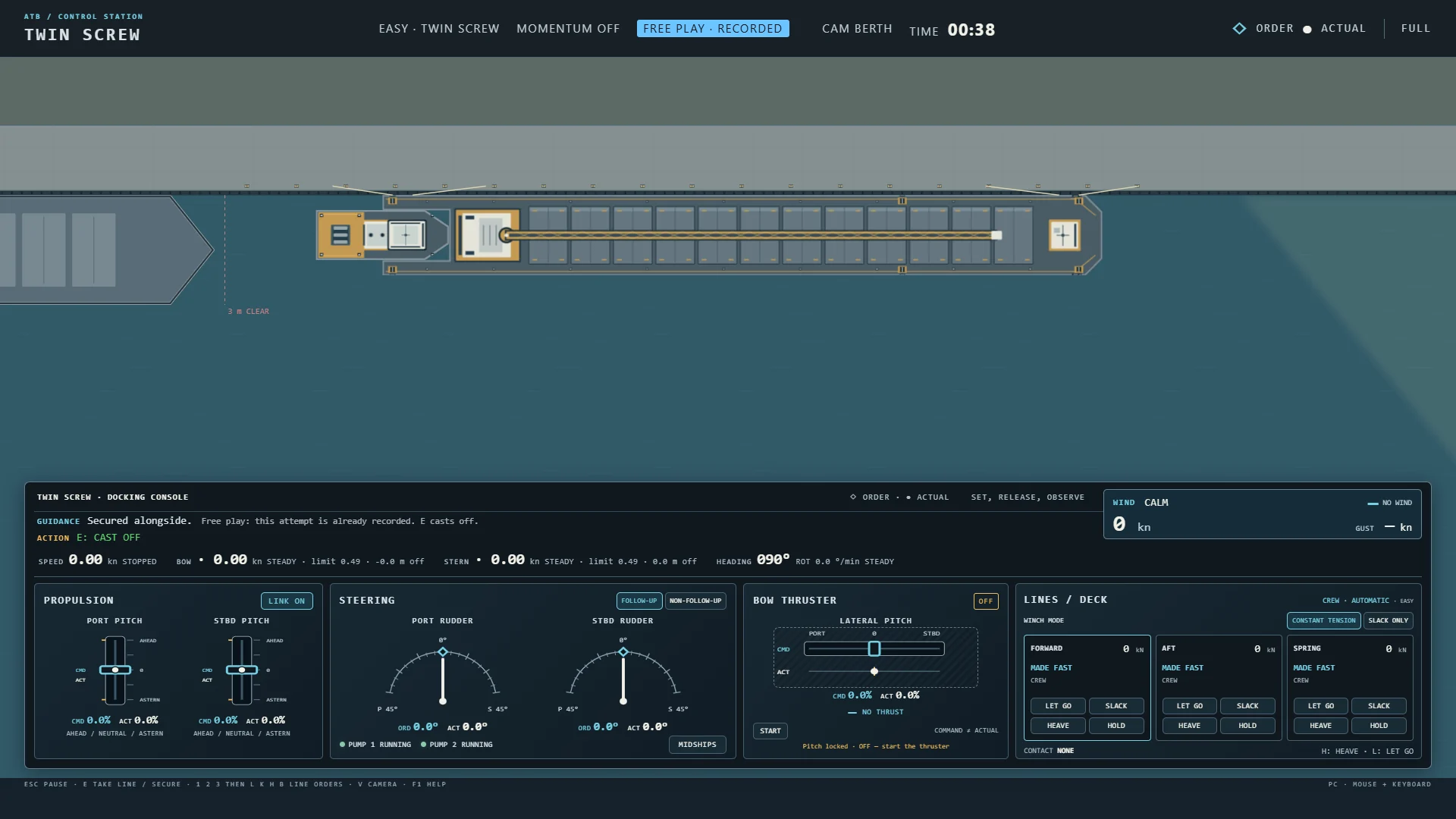
- Winches and crewWinch brake, constant tension, and per-line orders: heave, slack, hold, let go. A deck crew that does more or less for you depending on the tier.
- Contact modelFender, hard-structure and moored-vessel contact, with landing speeds reported in m/s and a clear line between a landing and damage.
- Four tiers per tugCalm water, steady wind, gusts, and an empty barge with no thruster. Harder means a new variable, not a smaller target.
- Momentum switchCompressed barge momentum by default so a berth takes five to eight minutes. Flip one switch for the full inertia of the unit, with separate personal bests.
- Five drills per tugOpen water, spin in place, walk sideways, stop from three knots, and the spring-line swing-in. Each scored on what matters: drift, headway, line load.
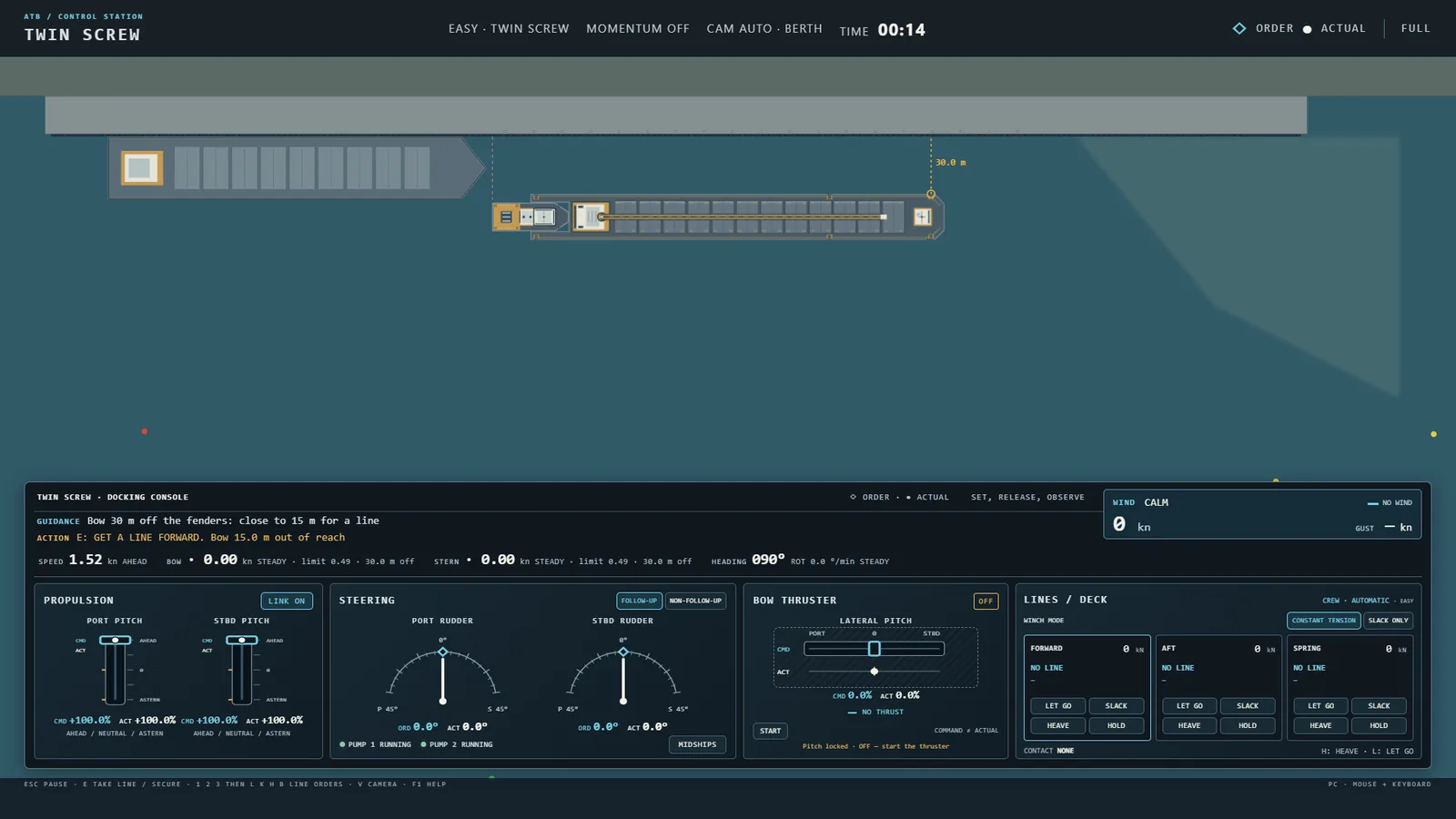
- Docking displayBow and stern closing speeds against the landing limit, heading and rate of turn, metres off at each end. Readable from any camera.
- ViewsAuto, follow, berth and area cameras with zoom. Night lights. An underwater view of the props and rudders.
- SoundProcedural engine, thruster, line, contact, wind and water sound. Mute with one key.
- ReplaysEvery attempt is replayable from its recorded inputs and gust seed, with pause, speed and phase skip. Export and import as a file.
- ControlsKeyboard, or mouse on the console. A full controls card on F1. Follow-up and non-follow-up steering.
- ProgressClean results unlock the next tier, per tug. Personal bests for time and max impact, saved in your browser.
- GuidanceA guidance line that reads the situation and tells you what a mate would tell you. Hints taper off as the tiers get harder and stop entirely on Hard.
What it does not model (yet or at all)
- No current, ice, shallow-water effect, bank suction or waves. Wind is the only environment.
- No prop walk.
- No articulation between tug and barge. The unit is rigid.
- No real vessels, ports, companies or bridge layouts. Everything is fictional.
- No multiplayer, no mobile, no controller support.
- Not a certified trainer, and it makes no claim to be one.
Planned, not built
- A campaign of fictional lake ports: a long grain wall, a fuel slip you back into, a hole between two moored ships, a turning basin barely longer than the unit, a lock chamber, an exposed T-dock on dolphins.
- Starboard-side-to and night variants of every berth.
Today there is one berth, a tight quay with a moored ship ahead, at four tiers on three tugs, plus the five drills.
03 / Screens
Drawn to be read, not admired.
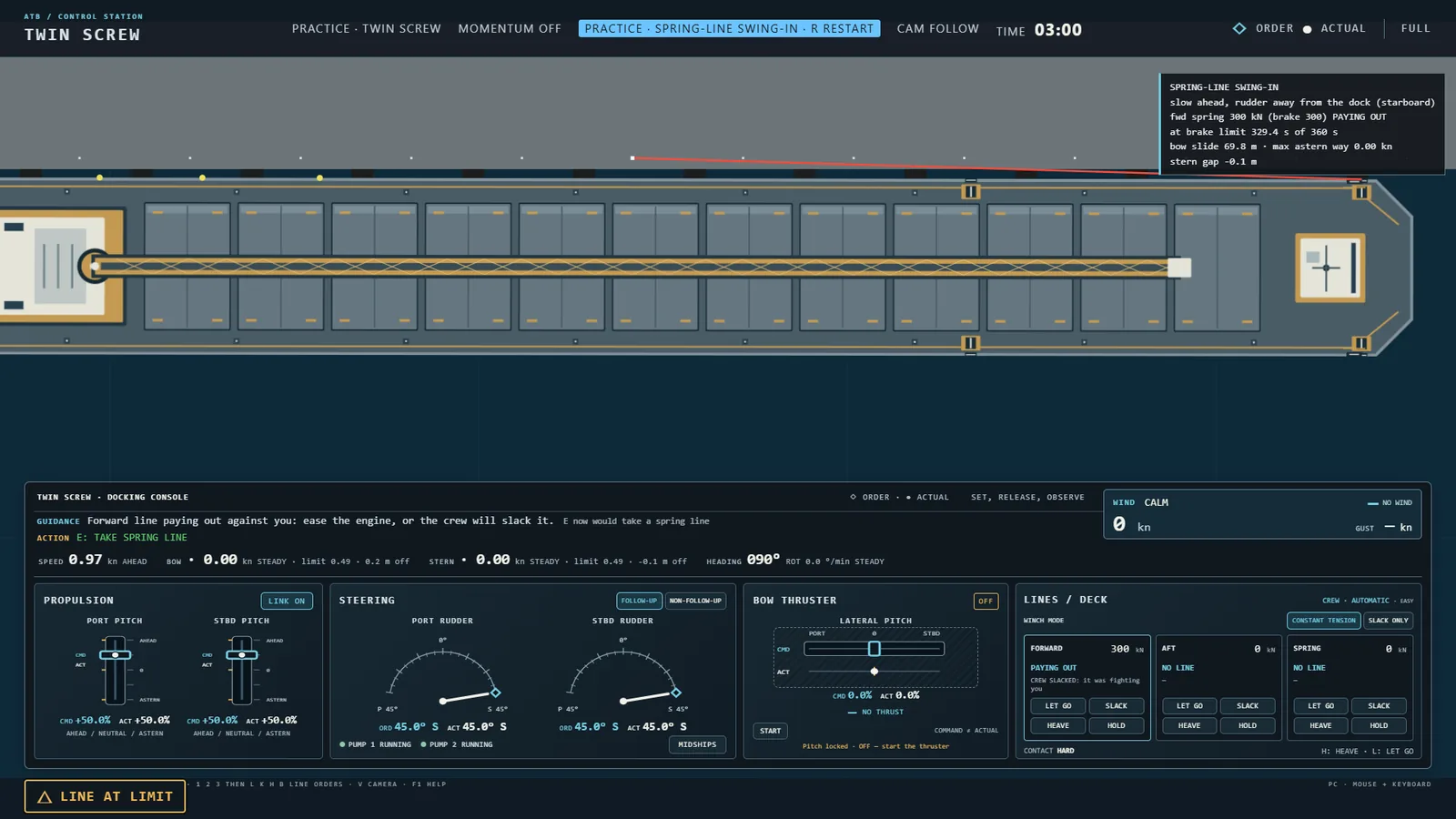
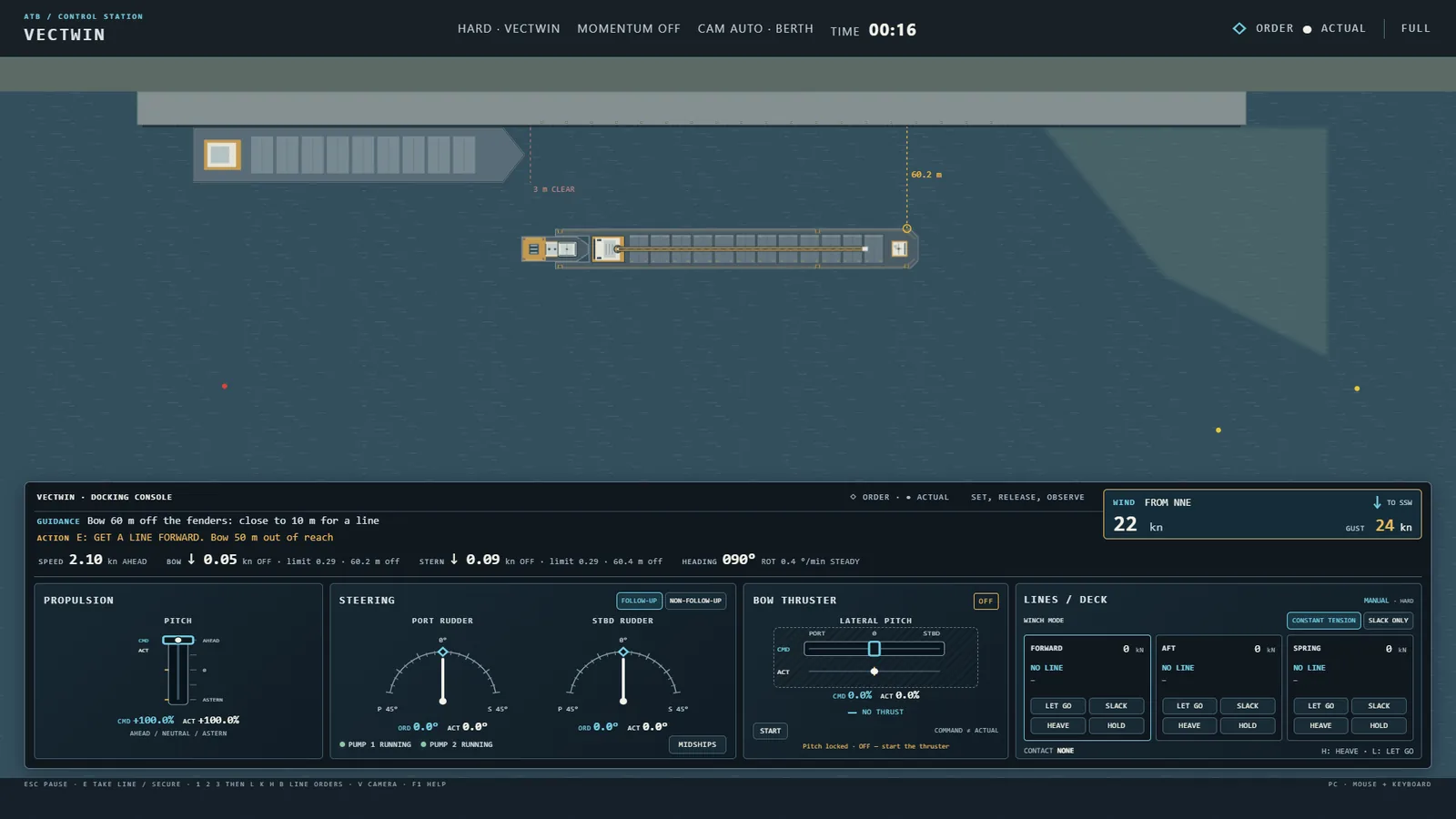
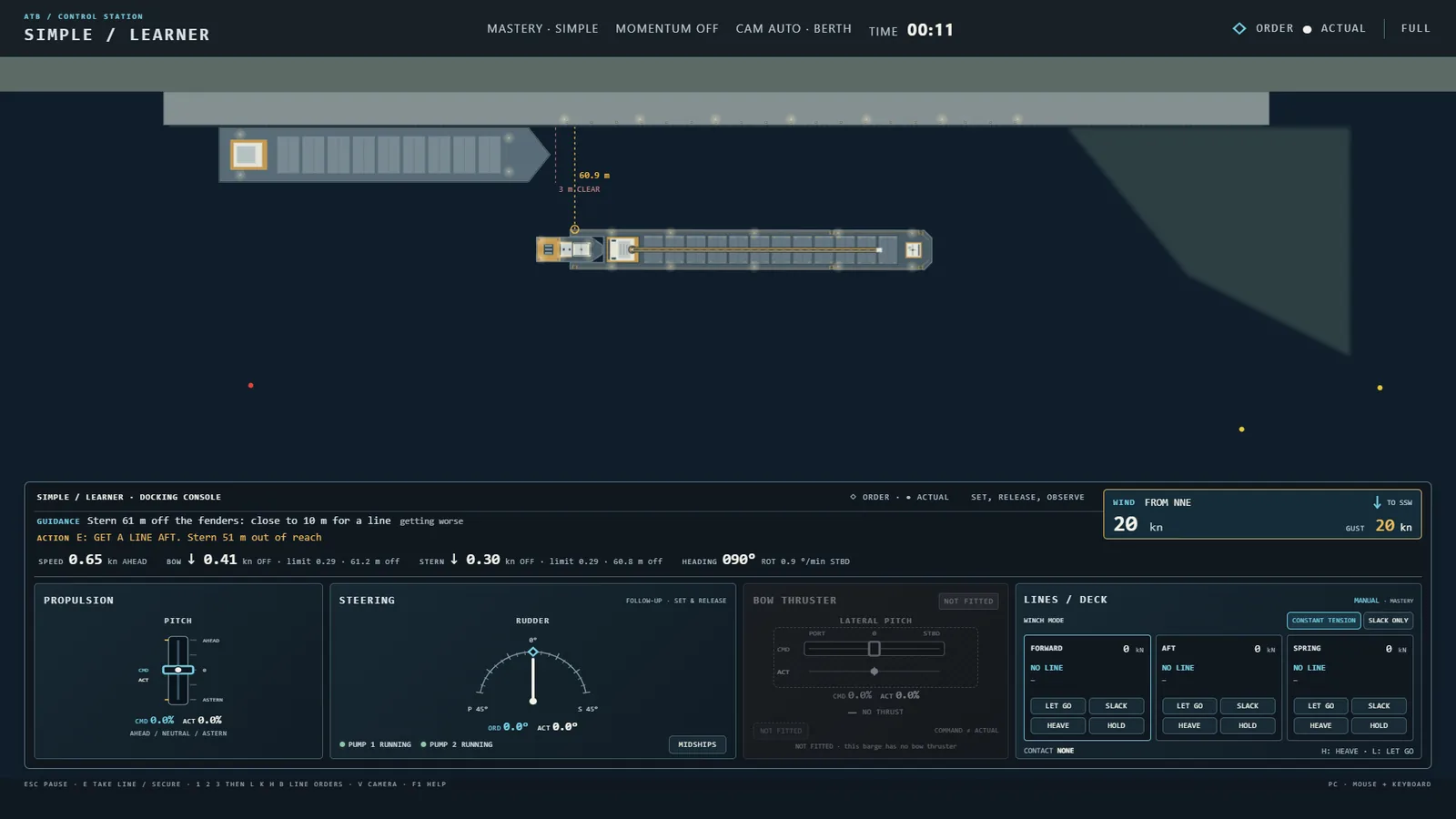
Every image on this page is a screenshot of the current build at 1920 by 1080. Nothing is mocked up.
04 / Take the station
Three tugs, three ways of thinking.
The same docking task. Three different consoles, and three different habits to build.
SIMPLE
One pitch lever, one rudder, follow-up steering only. The honest place to start: everything the unit does, it does slowly, and you learn to wait for it.
Spin her with hard-over rudder and a touch of ahead, then the bow thruster the other way. Ease down with the space bar.
TWIN SCREW
Two pitch levers, two rudders. Link them for a straight run, or split them: one ahead, one astern, and she turns with almost no headway. Walk her sideways with split engines and the thruster together.
Combined, split and independent control modes. Follow-up or non-follow-up steering.
VECTWIN
One pitch lever, two rudders behind one prop that steer the wash. Swing them together to steer, toe them in to brake, splay them one each way and the stern walks while the headway stays near zero.
Strong steering with a catch: splay alone will not stop her. You still have to manage the pitch.
05 / Choose the challenge
Every approach teaches you something.
Four tiers per tug. Each one adds a real variable. Two clean landings open the next tier for that tug, and lower tiers always stay open.
EASY
You handle the boat: engine, rudder, bow thruster. The deck crew handles the lines.
MEDIUM
Steady wind, and you call the lines. Hold to heave, let go the one fighting you. Hints only if you stall.
HARD
Gusts, full manual winches, no hints, and damage counts.
MASTERY
The weather might kill you. Empty barge: she will catch every gust. No bow thruster.
06 / Why it exists
Made by someone who works on these boats.
Most boat games treat a loaded tug-barge like a speedboat with a long hull. BERTH was built by someone who works on these units for a living and wanted the opposite: a sim where the right move is the one a real crew would make, and the wrong move costs you the way it does on the job.
That means a controllable-pitch thruster that takes time to spin up and fades with speed. A spring line that does real work, and a winch brake that pays out when you lean on it. A deck crew that talks like a deck crew. Readouts in knots and metres, not stars.
The handling model is written down, tuned by scripted runs, and is being checked against working ATB captains. Where it is wrong it gets fixed. Where it is simplified, this page says so. No real vessel, company, port or person is named or depicted anywhere in the game.
07 / For captains
If you drive these for a living, we want your notes.
No ATB captain has driven BERTH yet. The handling came from a physics model, scripted runs and one director who is not a captain. The feedback kit is a one-hour route through the game and a 27-question sheet about what felt right, what felt wrong, and what a real crew would never do.
It also lists what is deliberately simplified, so you do not spend your hour reporting things we already know. The sheet prints cleanly if you would rather fill it in on paper.
Note the build id from the footer.
08 / PC only
Runs in a desktop browser. Nothing to install.
BERTH is a PC game that happens to run in a browser tab. It needs a keyboard, a mouse and a window at least 1280 pixels wide. There is no phone or tablet version and no controller support.
| Minimum | Recommended | |
|---|---|---|
| Browser | Chrome or Edge, current version | Chrome, current version |
| OS | Windows 10 or 11, macOS or Linux, anything that runs Chrome | Windows 11 |
| Display | 1280 x 720 | 1920 x 1080 |
| Graphics | Integrated, tested on a current-generation Intel integrated GPU | Any |
| Input | Keyboard, or mouse | Keyboard and mouse |
| Sound | Optional, Web Audio | |
| Storage | Under 20 MB. Progress is saved in browser local storage. | |
| Network | Only to load the page. The game itself needs no connection. |
Firefox and Safari are untested. Progress lives in your browser profile, so clearing site data clears your records; export a replay if you want to keep a run. Press F1 in the game for the full controls card.